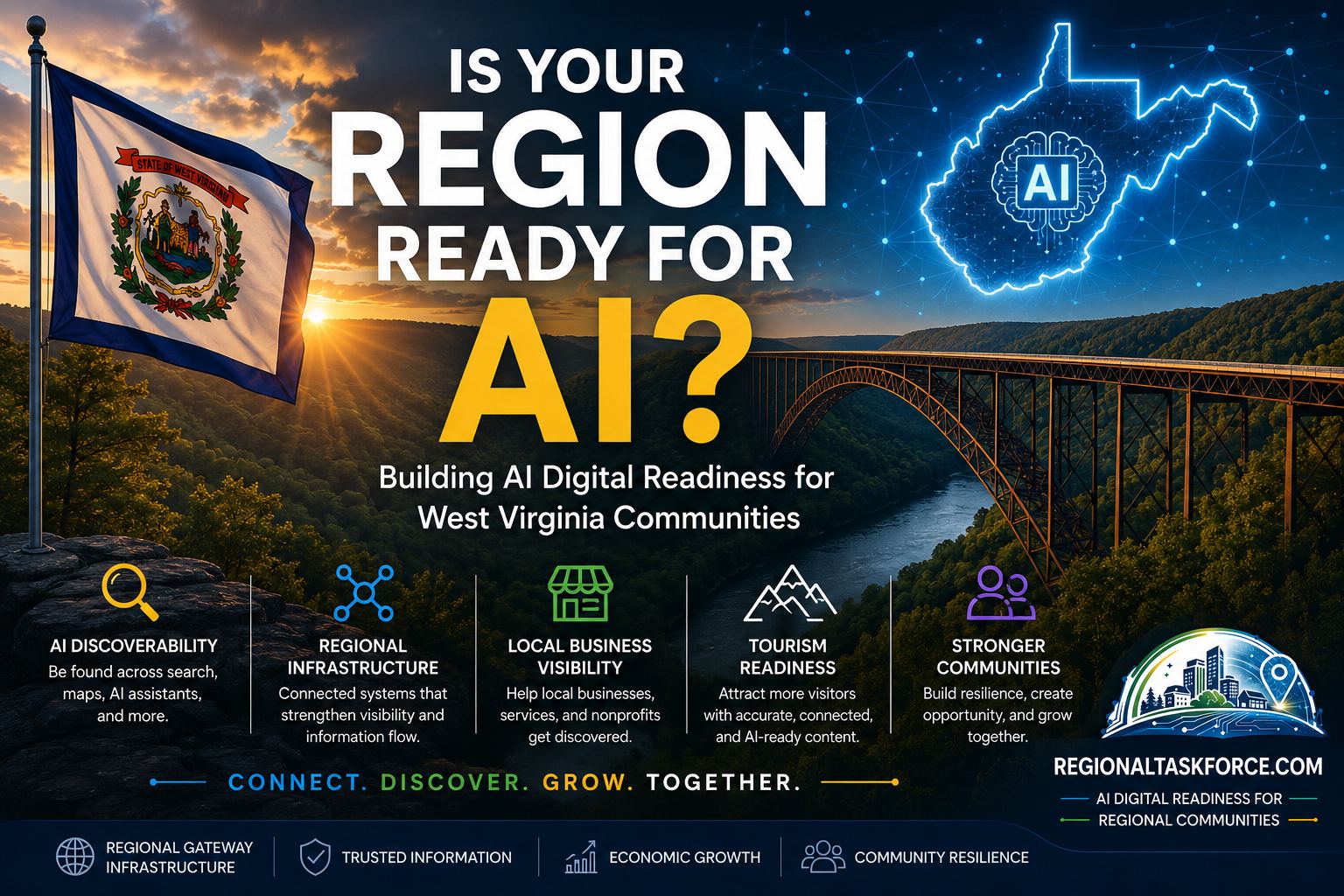
West Virginia Regional Ecosystem
AI Digital Readiness in West Virginia | Mountaineer Business Network
Discover how West Virginia communities, tourism regions, and local businesses can strengthen AI discoverability, digital visibility, regional gateway systems, and long-term online infrastructure readiness.

AI Digital Readiness: Transforming How Communities Thrive in the Age of Intelligent Discovery
AI Digital Readiness is the ability of a community, region, or local business ecosystem to be found, understood, and recommended by search engines, maps, AI assistants, voice tools, and connected digital platforms. For tourism economies, rural regions, downtown districts, recreation destinations, local services, nonprofits, lodging providers, restaurants, events, and property owners, it is becoming a core part of economic development.
The New Reality: How Visitors and Businesses Actually Discover Your Region
People no longer discover a region through one simple path. A visitor may begin with a Google search, compare options on a map, ask an AI assistant for a weekend itinerary, watch social media videos, check lodging availability, search for food nearby, and then rely on mobile navigation once they arrive. Discovery is now a connected journey across search, maps, ai tools, websites, directories, reviews, social platforms, and local publishing systems.
That shift creates a major challenge for communities that still depend mostly on fragmented social media posting. A post may create short-term attention, but it is often temporary, algorithm-dependent, and difficult for search engines or AI systems to interpret as permanent regional knowledge. A searchable web page, an accurate business listing, a structured events calendar, and a regional gateway website can continue to serve visitors, residents, and businesses long after a social post disappears from view.
AI Digital Readiness is the strategic response. It helps a community stay visible in an environment where ai, search engine optimization, zero click search, maps, voice queries, and mobile-first discovery increasingly influence where visitors go and which businesses customers choose. The goal is not simply to create more content. The goal is to establish digital infrastructure that makes a region easier to understand, recommend, navigate, and trust.
The transformation is from reactive posting to proactive digital ecosystem development. Instead of publishing isolated updates, a digitally ready region creates connected systems: local business directories, tourism pages, event calendars, lodging information, recreation guides, service listings, nonprofit resources, and AI-readable data that can be accessed across the web. This is how communities prepare for the digital future while supporting real-world growth.
Core shift: from reactive posting to proactive digital ecosystem development.
Why AI Digital Readiness is Essential for Modern Communities
Here is why AI Digital Readiness is becoming a critical initiative for regions that want sustainable visibility, stronger tourism demand, and long-term economic opportunity:
Regional Economic Development – Discoverability now has a direct influence on tourism revenue, local spending, business growth, and regional expansion. When visitors can easily identify things to do, places to stay, services to use, and events to attend, more money circulates through the local market. Digital infrastructure facilitates global connectivity, powering a wide array of communication and information technologies, which are essential for economic prosperity and national innovation.
Visitor Discovery Patterns – Travelers increasingly use search engines, AI assistants, maps, mobile devices, tourism searches, and social media before making decisions. Research shows that 56% of U.S. leisure travelers used AI tools for travel planning, booking, or in-destination assistance at least once in the past 12 months. In one destination portal study, AI referrals through assistant tools showed about an 8.26% booking-intent click rate compared with about 3.88% for organic search.
Community Resilience – Permanent, searchable digital infrastructure helps communities adapt when social media algorithms change, platforms lose reach, or online behavior shifts. A regional website, structured directory, connected publishing system, and AI-readable local ecosystem create a more stable foundation than temporary posts alone.
Competitive Advantage – Regions that organize their data, publish consistently, and connect local businesses through a shared platform can stay relevant while less prepared communities remain difficult to find. Digital infrastructure is critical for companies to operate, innovate, and grow, as it underpins all aspects of a connected business's operations.
Future-Proofing – AI search, voice discovery, map-based recommendations, zero click search, and automated travel planning will continue to expand. Access to robust digital infrastructure capable of processing, storing, and transmitting data is increasingly vital for countries to keep pace with international Artificial Intelligence (AI) markets.
Instead of treating digital transformation as a side project, forward-looking communities are beginning to treat it like roads, utilities, broadband, and public information systems: essential infrastructure for modern regional life.
How AI-Powered Discovery Actually Works
AI-powered discovery is not magic. It is a process built on data, structured content, signals of trust, location information, publishing continuity, and the ability of systems to connect relevant information. A person asks a question, a search engine or AI assistant interprets intent, maps and listings provide location context, and web content helps determine which places, businesses, events, and services should be surfaced.
Step 1: AI Search and Voice Queries
When someone asks, “What are the best small towns for a weekend trip near me?” or “Where can I find lodging, food, and hiking in this region?”, AI assistants and search engines process the query through location signals, semantic context, reviews, business listings, local content, and structured data. Voice search adds another layer, because many spoken searches are local, immediate, and action-oriented.
For a community, this means searchable web content must be clear, organized, and specific. AI systems need to understand what a place is, where it is, what services operate there, what visitors can do, and why the region is relevant to the search. Strong search engine optimization still matters, but modern readiness also requires content that can be interpreted by AI assistants, maps, and answer engines.
A digitally prepared region does not rely on one page or one platform. It creates many connected signals: tourism guides, business profiles, event listings, neighborhood descriptions, lodging pages, recreation resources, food and service directories, and current local updates.
Step 2: Maps and Mobile Discovery
Maps are now one of the most important gateways into local economies. Visitors use maps to choose restaurants, find parking, locate lodging, compare attractions, plan routes, and identify services nearby. Mobile-first behavior means that a large share of discovery happens on the phone, often while a visitor is already moving through a region.
Points of interest, accurate business listings, hours, reviews, photos, service categories, accessibility information, and location-based details all influence whether visitors can confidently take the next step. If the information is missing, outdated, or inconsistent, the region loses visibility and customers may choose another option.
The expansion of 5G mobile networks and the introduction of next generation 6G are set to deliver faster, more reliable mobile connectivity, requiring upgrades to digital infrastructure to handle increased data demands. For communities, that means regional digital readiness includes both content and connectivity.
Step 3: Connected Information Ecosystems
A strong regional gateway does more than host isolated articles. It connects tourism, events, lodging, recreation, food, nonprofits, local services, property owners, and businesses into one coherent digital ecosystem. This creates a more complete visitor resource and a stronger signal for AI-powered discovery.
Connected platforms also help residents and local organizations contribute input. A chamber of commerce, tourism office, economic development team, business network, and community partners can all support publishing continuity. When information is regularly updated and linked across the region, search engines and AI systems have more confidence in the data.
Digital infrastructure is the physical hardware and software-based technologies that enable digital services, including IT systems and networks that allow organizations to operate and communicate effectively. In regional discovery, that infrastructure includes websites, databases, directories, publishing tools, maps, APIs, cloud services, data centers, broadband access, and the governance process that keeps information current.
No guesswork. No scattered effort. Just a structured path toward better visibility.
Essential Components of AI Digital Readiness
AI Digital Readiness requires more than a website. It depends on the systems, standards, and community habits that allow local information to remain accurate, accessible, and useful over time.
Structured Regional Content – Communities need organized, searchable information about tourism, businesses, events, services, recreation, lodging, food, nonprofits, and local resources. This includes pages that answer real questions, identify specific places, and connect users to next steps. A well-built web page should help both people and AI tools understand what exists in the region and why it matters.
Connected Publishing Systems – A region needs integrated platforms that keep information consistent and up to date. Event calendars, business directories, tourism guides, service listings, and local news resources should not operate as disconnected silos. Publishing continuity is what helps a community stay visible over time.
AI-Readable Data Architecture – Content should be formatted so search engines, maps, and AI assistants can understand and surface it. That includes structured data, consistent business names, addresses, phone numbers, hours, categories, service areas, images, and descriptions. Access to robust digital infrastructure capable of processing, storing, and transmitting data has become increasingly vital for businesses to keep pace with international AI markets.
Regional Gateway Infrastructure – A centralized digital hub gives visitors, residents, companies, and partners a reliable place to find comprehensive local information. A gateway platform can connect tourism pages, local business profiles, maps, events, lodging options, recreation guides, and community resources into one searchable ecosystem.
Community Information Flow – AI Digital Readiness depends on participation. Businesses, nonprofits, event organizers, tourism partners, employees, residents, and local leaders all help create the information layer that makes a region discoverable. The strongest systems make it easy to submit updates, identify gaps, enhance listings, and support shared visibility.
Cloud services and edge computing are changing digital infrastructure by allowing businesses to access on-demand services and process data closer to its source, enhancing latency and efficiency, particularly in support of 5G and IoT growth. For communities, this means digital readiness will increasingly depend on modern systems that can support real-time updates, mobile use, data processing, and connected regional services.
Communities Leading in Digital Readiness
The communities making progress are not simply posting more often. They are building connected digital ecosystems that serve visitors and local businesses across the entire discovery journey.
Visit Outback NSW in Australia is a strong example of long-term regional digital transformation. Over several years, the destination evolved from a static brochure-style website into a more mobile-optimized, content-rich regional platform. During that period, mobile traffic share grew from about 1% to about 16%, and the region saw improvements in visibility, visitation patterns, and support for local operators.
A Mediterranean destination portal study covering 1.6 million sessions from April 2022 to January 2026 also shows how visitor behavior is changing. About 83% of sessions were mobile, while desktop visitors converted at higher rates for booking clicks. The same study found that AI referrals through assistant tools produced about an 8.26% booking-intent click rate compared with about 3.88% for organic search, demonstrating that AI-driven users can arrive with strong intent even when their sessions are shorter.
These examples demonstrate the value of structured content, mobile readiness, connected gateway systems, and regional publishing continuity. They also show that visibility alone is not enough. Communities need interfaces and pathways that help visitors move from interest to action: booking a room, attending an event, choosing a restaurant, finding recreation, contacting a service provider, or exploring a downtown district.
Mountaineer Business Network in context: structured regional networks can support local business discoverability, tourism visibility, connected regional information, searchable community resources, and long-term digital infrastructure readiness.
Structured regional networks such as Mountaineer Business Network can play an important role in this type of readiness. A network can support local business discoverability, tourism visibility, connected regional information, searchable community resources, and long-term digital infrastructure readiness. When many businesses participate in a shared platform, the community benefits from stronger data consistency, more relevant local content, and a broader digital footprint.
For small businesses, this network effect matters. A single business may not have the time, costs, technology, or team to create advanced AI-readable content alone. A regional platform can help distribute that capacity across the community.
Who Benefits from AI Digital Readiness
AI Digital Readiness is not only for tourism offices or technology companies. It benefits any region where people need to discover places, services, events, resources, and economic opportunity.
Tourism-Dependent Communities – Regions that rely on visitors for lodging, food, recreation, events, retail, and local services need to be discoverable across search, maps, social media, AI assistants, and mobile platforms. Tourism visibility now depends on how well a region can connect its experiences into a searchable digital ecosystem.
Rural and Small Towns – Smaller communities often compete against larger metropolitan markets with bigger budgets and more content. A connected gateway website, shared business directory, and structured local publishing process can help rural regions stay relevant and stay visible in a crowded digital world.
Local Business Ecosystems – Restaurants, lodging providers, shops, service companies, nonprofits, venues, recreation operators, and property owners all benefit when the region has stronger digital infrastructure. Customers are more likely to engage when they can find accurate hours, services, locations, reviews, and nearby experiences.
Economic Development Organizations – Groups responsible for competitiveness, workforce attraction, business retention, tourism strategy, and modernization need digital readiness as part of their planning. Choosing the right business model for digital infrastructure deployment is essential to ensure that the resulting business plan is economically sustainable and meets community needs.
AI Digital Readiness also supports residents. A better digital ecosystem helps people find local services, community events, nonprofit resources, public information, and regional opportunities. It improves quality of life while strengthening the market for local businesses.
Approaches to Building Regional Digital Readiness
Every community begins at a different stage. Some already have a tourism website but lack connected business data. Some have active social media but no permanent searchable content. Some have strong local organizations but no shared publishing system. The right path depends on resources, goals, partners, connectivity, and the intended long-term role of the platform.
Community-Led Digital Infrastructure
A community-led approach brings together local businesses, tourism organizations, chambers of commerce, nonprofits, event organizers, property owners, residents, and public partners to create shared digital infrastructure. This can begin with practical next steps: audit existing websites, identify outdated listings, map key tourism assets, create a regional content plan, and establish a publishing process.
Shared platforms reduce duplication. Instead of each organization trying to operate alone, the community can build a connected system for events, business profiles, tourism pages, recreation guides, and local services. This helps smaller businesses gain visibility without needing advanced technical expertise.
Automation and AI are expected to transform digital infrastructure by streamlining operations and improving efficiency, with AI-powered solutions anticipated in networking for design, provisioning, maintenance, optimization, and cybersecurity. As these ai solutions become more common, communities with organized data and clear systems will be better positioned to adapt.
Regional Business Network Integration
Existing business networks can become powerful engines for AI Digital Readiness. A network already has relationships, trust, local knowledge, and participation from companies that serve residents and visitors. When that network adds structured publishing, searchable directories, consistent business data, and regional content, it can enhance visibility across the entire market.
Mountaineer Business Network is an example of how a structured regional network can support this work. By connecting businesses, services, events, tourism resources, and community information, a network-style platform can help
A Regional Gateway for the AI Discovery Era
Mountaineer Business Network is positioned to help West Virginia businesses, communities, tourism regions, and local resources become easier to find, understand, and connect with through structured regional visibility.